Rao Jodha, a Rathore ruler, founded Jodhpur and began Mehrangarh on a hill called Bhaurcheeria in 1459. Later Rathore rulers added palaces, gates and walls over the following centuries, creating one of the largest forts in Rajasthan, with walls rising sheer from the rock.
The fort is managed by the Mehrangarh Museum Trust, set up by the former royal family, which runs the museum inside the palaces. It is not on the UNESCO list, but is among the best-preserved and best-presented forts in India.
Quick answer
Mehrangarh Fort, founded by Rao Jodha in 1459, stands above Jodhpur's old city and is run by the Mehrangarh Museum Trust. Inside are palace rooms such as the Phool Mahal and Sheesh Mahal, and museum galleries of palanquins, howdahs, arms and paintings. Allow three hours, add Jaswant Thada and the Rao Jodha Desert Rock Park, and visit from October to March.
Key takeaways
- Founded by Rao Jodha in 1459; expanded by later Rathore rulers.
- Managed by the Mehrangarh Museum Trust, with a well-run museum and audio guide.
- A lift helps visitors avoid the steepest climb.
- Jaswant Thada and the Rao Jodha Desert Rock Park are next door.
- The Rajasthan International Folk Festival is held at the fort each October.
What to see
The gates
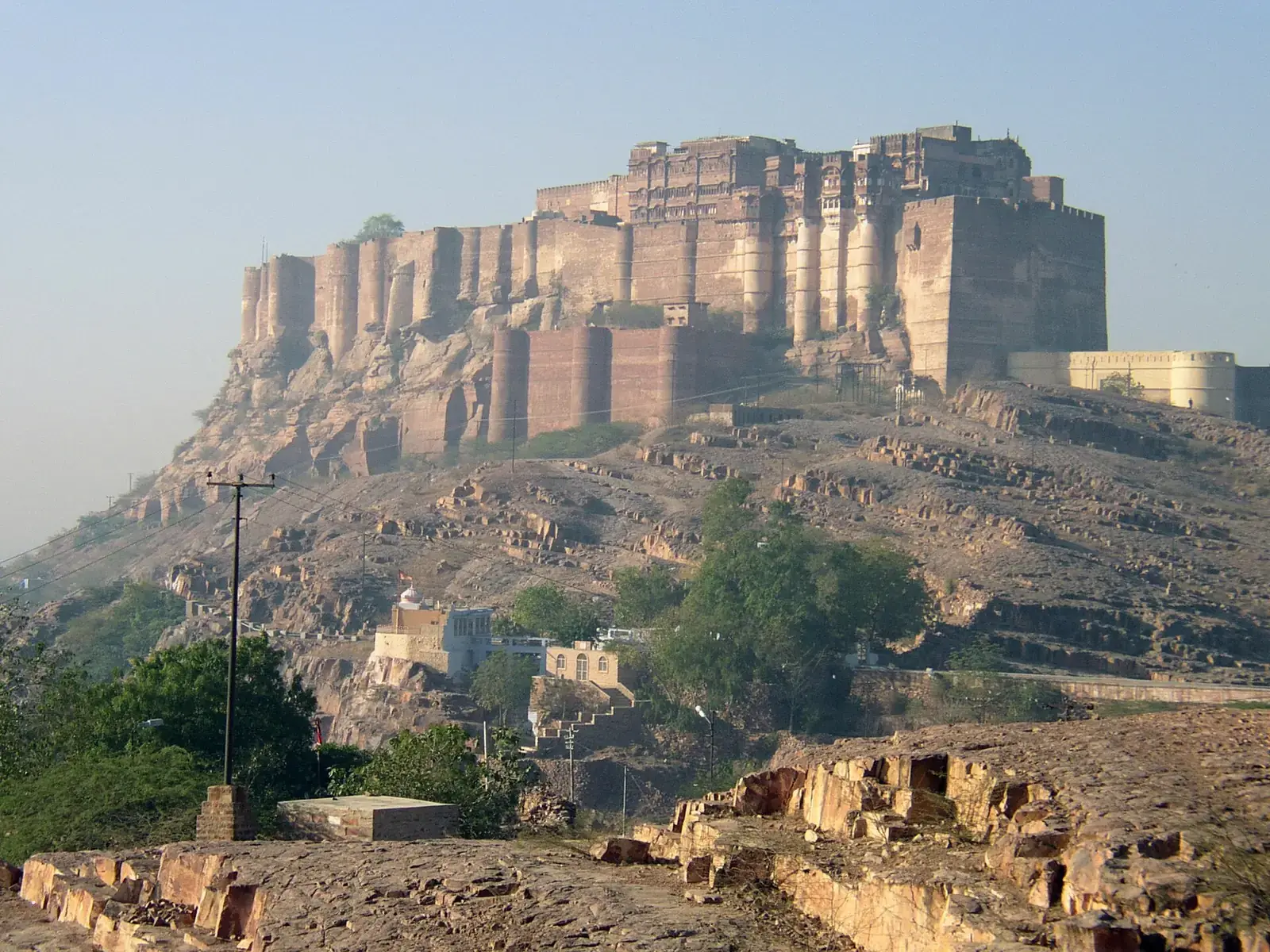
Seven gates line the climb, including Jai Pol and Loha Pol, where handprints recall royal women who committed sati; the site marks this history rather than celebrating it.
Palace rooms
The Phool Mahal, Sheesh Mahal and Moti Mahal, with painted ceilings, mirror work and stained glass.
Museum galleries
Palanquins, elephant howdahs, arms, textiles and Marwar miniature paintings.
The ramparts
Old cannons and views over the blue houses of the old city.
Visiting practicalities
- Open daily; check current hours with the Mehrangarh Museum Trust.
- Tickets are sold by the trust; the audio guide is well worth it.
- A lift runs part of the way up; otherwise the ramp is steep.
- Allow about three hours for the fort and museum.
- A zipline has operated over the fort's walls and lakes; check if it is running.
Nearby
Jaswant Thada
A white marble memorial (cenotaph) built in 1899 for Maharaja Jaswant Singh II, a short drive or walk from the fort.
Rao Jodha Desert Rock Park
A restored landscape of native desert plants below the fort walls, with walking trails.
The old city
The clock tower and Sardar Market, the stepwell at Toorji ka Jhalra, and Umaid Bhawan Palace.
Festivals
The Rajasthan International Folk Festival (RIFF) brings folk musicians from Rajasthan and beyond to the fort each October, around the full moon of Sharad Purnima. The World Sacred Spirit Festival has also been held at the fort and at Nagaur. Check dates each year.
A short history
Mehrangarh was the seat of the Rathores of Marwar. Rao Jodha moved his capital from Mandore to the rocky hill in 1459, and the fort was enlarged over five centuries; parts of the walls still bear marks of cannon fire from 19th-century sieges. After Independence the former royal family set up the Mehrangarh Museum Trust, which restored the palaces and opened the museum.
Best time and a suggested day
| Time | Plan |
|---|---|
| 9 am | Mehrangarh Fort and museum |
| 12:30 pm | Jaswant Thada |
| Afternoon | Rao Jodha Desert Rock Park, or rest |
| Evening | Clock tower market and dinner with a fort view |
October to March is best; summers in Jodhpur are extremely hot.
Safety
- Timings, closures and ticket rules are set by the ASI, state archaeology departments or site trusts and change from time to time; check the official website before you go.
- Do not climb on or touch carvings, and follow the site's rules on photography, drones and tripods.
- Carry water and a hat; many sites have little shade, and Indian summers are hot.
- Take care on the steep ramp and uneven stone floors.
What to pack
- Comfortable shoes
- Hat, sunscreen and water
- Photo ID
- Headphones for the audio guide
- A light jacket for winter evenings
Want to explore India's heritage on a route built around you?
FAQs
Who built Mehrangarh Fort?
Rao Jodha began the fort in 1459; later Rathore rulers expanded it.
How long do I need at Mehrangarh Fort?
About three hours for the fort and museum.
What is inside the Mehrangarh museum?
Palanquins, elephant howdahs, arms, textiles and Marwar miniature paintings, in restored palace rooms.
Is there a lift at Mehrangarh?
Yes, a lift runs part of the way up, which helps older visitors.
Is Mehrangarh a UNESCO site?
No. It is managed by the Mehrangarh Museum Trust and is not on the UNESCO list.
When is the Rajasthan International Folk Festival?
Each October at the fort, around Sharad Purnima; check dates for the year.