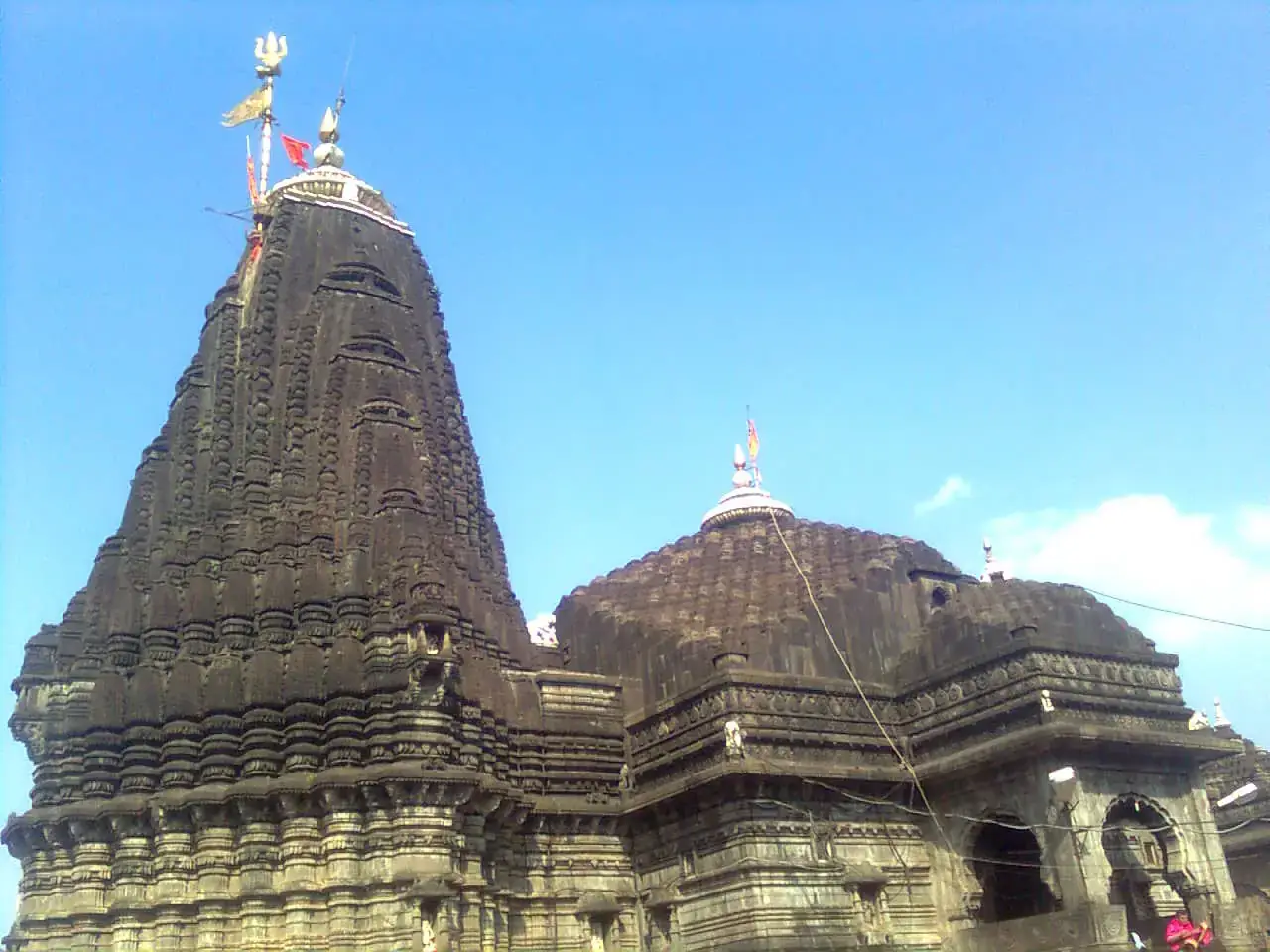
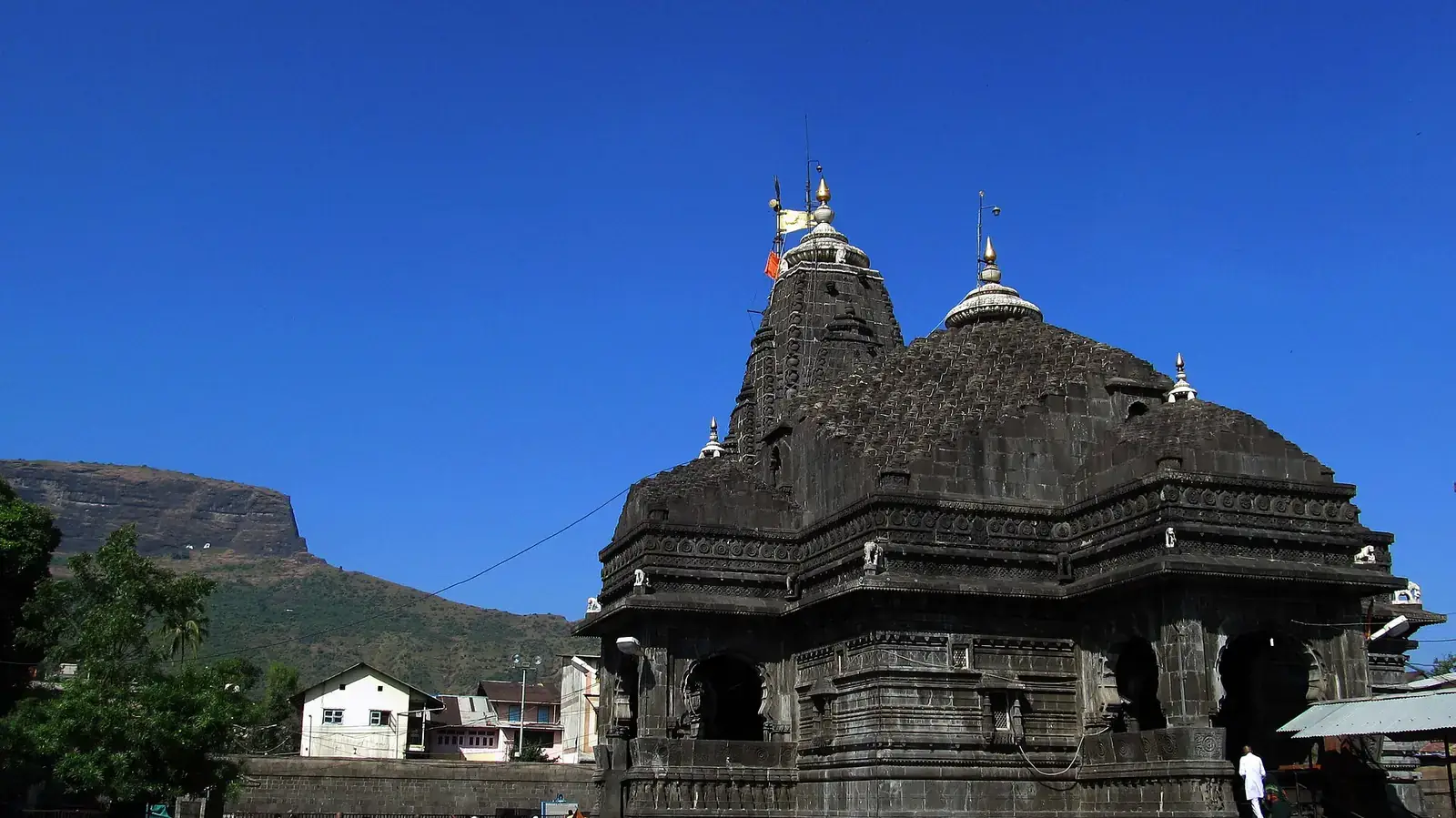
Trimbakeshwar Temple is in the small town of Trimbak, about 30 km west of Nashik. The present black-stone temple was built in the 18th century under the Peshwa Balaji Bajirao (Nanasaheb). Its linga is unusual: set in a small hollow, it has three small forms that devotees identify with Brahma, Vishnu and Shiva, which is why it is also called Tryambakeshwar.
The town is also where the Godavari is traditionally said to rise, on the Brahmagiri hill above, and it is one of the four sites of the Kumbh Mela. Many families come here for rituals such as Narayan Nagbali and Kaal Sarp puja, performed by local priests.
Quick answer
Trimbakeshwar Jyotirlinga is at Trimbak, about 30 km (roughly 45 minutes) from Nashik and about 180 km from Mumbai. General darshan is free and the queue can take from under an hour to several hours on Mondays, festivals and holidays. Pilgrims often bathe at the Kushavarta tank and visit Brahmagiri, the source of the Godavari. October to March is the most comfortable time to visit.
Key takeaways
- Trimbakeshwar is about 30 km from Nashik and about 180 km from Mumbai.
- The linga has three small forms, identified with Brahma, Vishnu and Shiva.
- Queues are longest on Mondays, Shravan, Maha Shivratri and holidays.
- Priests at Trimbak perform rituals such as Narayan Nagbali; agree the details and fee beforehand.
- Trimbakeshwar hosts the Simhastha Kumbh with Nashik; the next falls in 2027.
The temple
The temple is built of black basalt in the Nagara style, with a tall carved shikhara and a walled courtyard. Darshan of the linga is usually taken from a short distance; access to the sanctum is limited to certain rituals and times.
The linga is often covered by a silver or gold mask and crown on special occasions, which are displayed to devotees.
At a glance
Key facts for visitors.
- Location
- Trimbak, Nashik district
- Deity
- Shiva (Tryambakeshwar)
- Built
- 18th century (present structure)
- Nearest city
- Nashik, about 30 km
Darshan and rituals
- General darshan is free; the temple has also offered a paid darshan queue. Use only the temple's own counters or website.
- Mornings on weekdays are usually quieter; Mondays and festivals are busiest.
- Rituals such as Narayan Nagbali, Kaal Sarp Shanti and Tripindi Shraddha are performed by registered priests in Trimbak. Agree the ritual, duration and fee in advance.
- Men performing some rituals are asked to wear a dhoti; for general darshan, modest clothes are enough.
- Phones, cameras and leather items may not be allowed inside; use the lockers or leave them in the car.
Around Trimbak
Kushavarta tank
The sacred tank where pilgrims bathe before darshan, also the main bathing site during the Simhastha at Trimbak.
Brahmagiri and Gangadwar
The hill above the town, climbed on a long flight of steps to shrines associated with the Godavari's source. Allow half a day; the steps are steep.
Anjaneri
A hill about 7 km away, believed by devotees to be the birthplace of Hanuman, with a popular trek in the monsoon.
Nashik
Panchavati, Ram Kund and Kalaram temple on the Godavari, plus caves and vineyards.
How to reach
- From Nashik: about 30 km by taxi or state transport (MSRTC) bus, around 45 minutes.
- From Mumbai: about 180 km by road via Igatpuri, around four to five hours.
- By train: Nashik Road station, about 40 km away.
- By air: Nashik (Ozar) airport has limited flights; Mumbai and Pune are the main airports.
Best time and the Kumbh
October to March is pleasant for temple visits. The monsoon (June to September) turns Brahmagiri green and misty, but climbs are slippery. Shravan Mondays and Maha Shivratri bring the largest crowds.
Nashik and Trimbakeshwar host the Simhastha Kumbh every twelve years. For 2027, official announcements put the main bathing (Amrit Snan) dates on 2 August, 31 August and 11 to 12 September 2027, with the last at Trimbakeshwar on 12 September. Expect very heavy crowds, road restrictions and higher prices around these dates.
See our Kumbh Mela guide for the full schedule.
Safety
- Darshan waits vary from minutes to many hours; no one can guarantee quick darshan, so plan buffer time.
- Dress modestly (shoulders and knees covered) and follow the temple's rules on phones, bags and photography.
- Agree fees for rituals in advance, and use priests registered at the temple town.
- Take care on the Brahmagiri steps, especially in rain.
What to pack
- Modest clothes (a dhoti if you plan certain rituals)
- Towel and a change of clothes if bathing at Kushavarta
- Rain jacket in the monsoon
- Water for the Brahmagiri climb
Want this pilgrimage turned into a practical itinerary?
FAQs
How far is Trimbakeshwar from Nashik?
About 30 km, or around 45 minutes by road.
What is special about the Trimbakeshwar linga?
It sits in a hollow and has three small forms that devotees identify with Brahma, Vishnu and Shiva.
How long does darshan take at Trimbakeshwar?
From under an hour on quiet weekdays to several hours on Mondays and festivals.
What rituals are performed at Trimbakeshwar?
Rituals such as Narayan Nagbali, Kaal Sarp Shanti and Tripindi Shraddha, performed by registered priests in the town.
When is the next Kumbh at Trimbakeshwar?
The Nashik-Trimbakeshwar Simhastha falls in 2027, with the last Amrit Snan at Trimbakeshwar on 12 September 2027 as announced.