Delhi's Third City
Most visitors to Delhi never make it to Tughlaqabad — and that's exactly what makes it worth the detour. Built between 1321 and 1325 by Sultan Ghiyasuddin Tughlaq, founder of the Tughlaq dynasty, Tughlaqabad was the third of Delhi's medieval "cities" — an entire fortified capital raised in just a few frantic years of construction. It was also, remarkably, abandoned within a couple of decades of being built, leaving behind one of the most atmospheric, underrated ruins anywhere in India.
Where Red Fort and Qutub Minar draw steady streams of tour groups, Tughlaqabad's colossal stone ramparts — stretching for kilometres across a rocky, scrub-covered ridge — sit largely empty on most days. It's a strange, slightly eerie feeling: walking through gate after gate of a city built to house an empire, with almost no one else around except the occasional local, a langur troop, or a photographer chasing the light.
That emptiness has a story behind it — a genuine, widely told piece of Delhi folklore involving a Sufi saint, a labour dispute, and a curse that's stuck to the site for seven centuries. We'll get to that. First, the practical basics.
🏰 Tughlaqabad at a Glance
Interested in the history? See our guide to heritage in Delhi.
Best Time to Visit Tughlaqabad
Tughlaqabad is almost entirely outdoors, exposed, and largely unshaded — a rocky, open ridge with very little tree cover across most of the citadel. Timing your visit matters more here than at monuments with covered interiors or shaded gardens.
Cool, dry days make the long, exposed walk across the ramparts genuinely pleasant, and the low winter light is excellent for photography.
The exposed stone ramparts trap and radiate heat brutally by mid-morning — visit only at first light or skip this window.
Monsoon greenery against grey stone is striking, but weathered steps and uneven surfaces get slick — wear grippy shoes.
Aim to arrive shortly after opening — cooler temperatures, softer light, and the fewest people, since Tughlaqabad is never really crowded.
Our pick: a weekday morning between November and February. You'll likely have long stretches of the ramparts entirely to yourself.
How to Reach Tughlaqabad
Tughlaqabad sits in South Delhi near Badarpur, and is genuinely easy to reach thanks to a dedicated metro station right next to it — one reason there's no excuse for it to stay as under-visited as it is.
- By Metro: Take the Violet Line to Tughlaqabad station, which sits close to the fort. It's the single easiest way in from almost anywhere in Delhi, avoiding traffic entirely.
- From the station: A short auto-rickshaw ride (a few minutes) or a 15–20 minute walk covers the distance to the main entrance, depending on the exit and the day's heat.
- By Road: Well connected via the Mehrauli-Badarpur Road; a cab or app-based ride from central Delhi typically takes 40–60 minutes depending on traffic.
The Massive Ramparts & 13 Gates
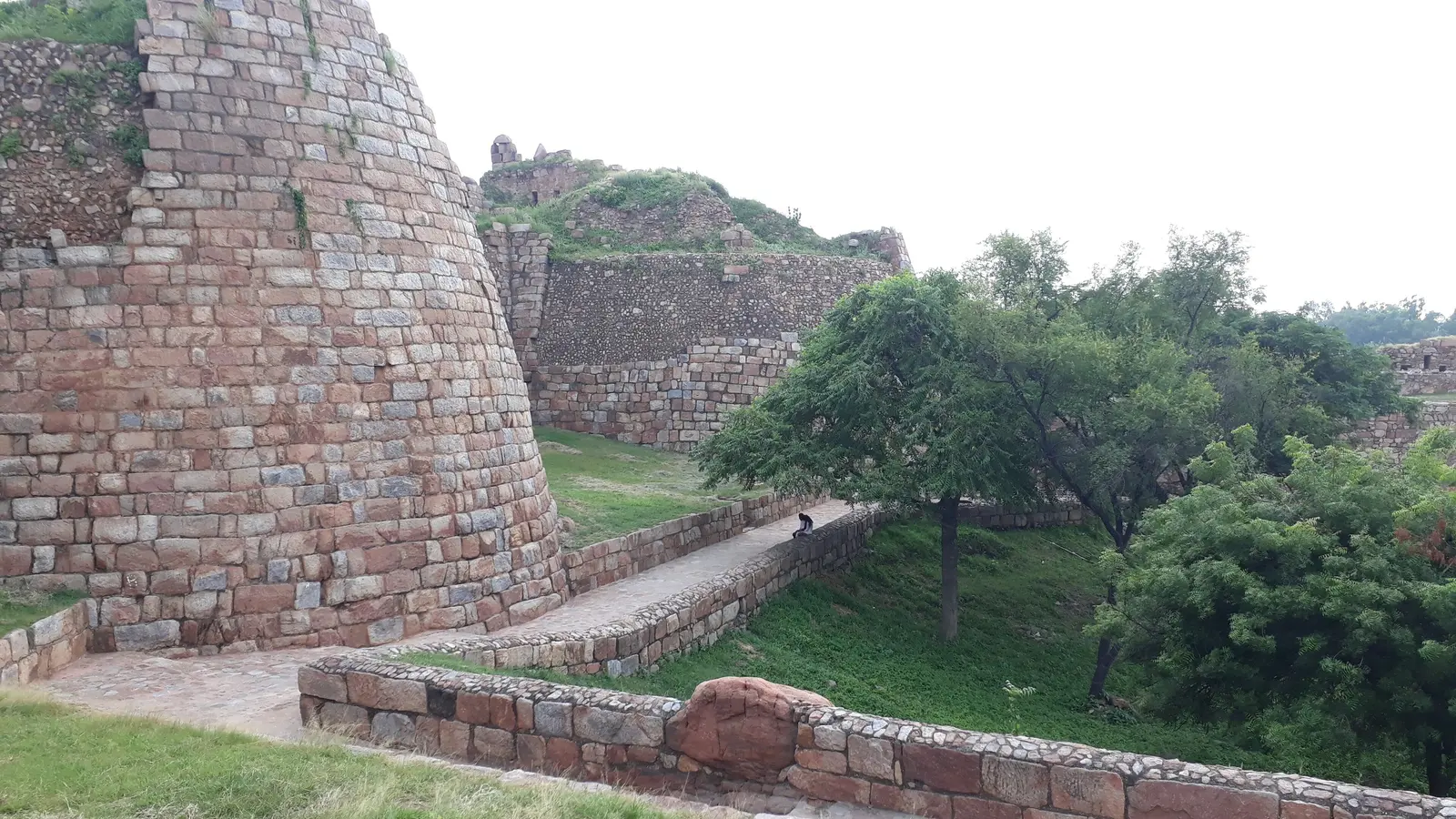
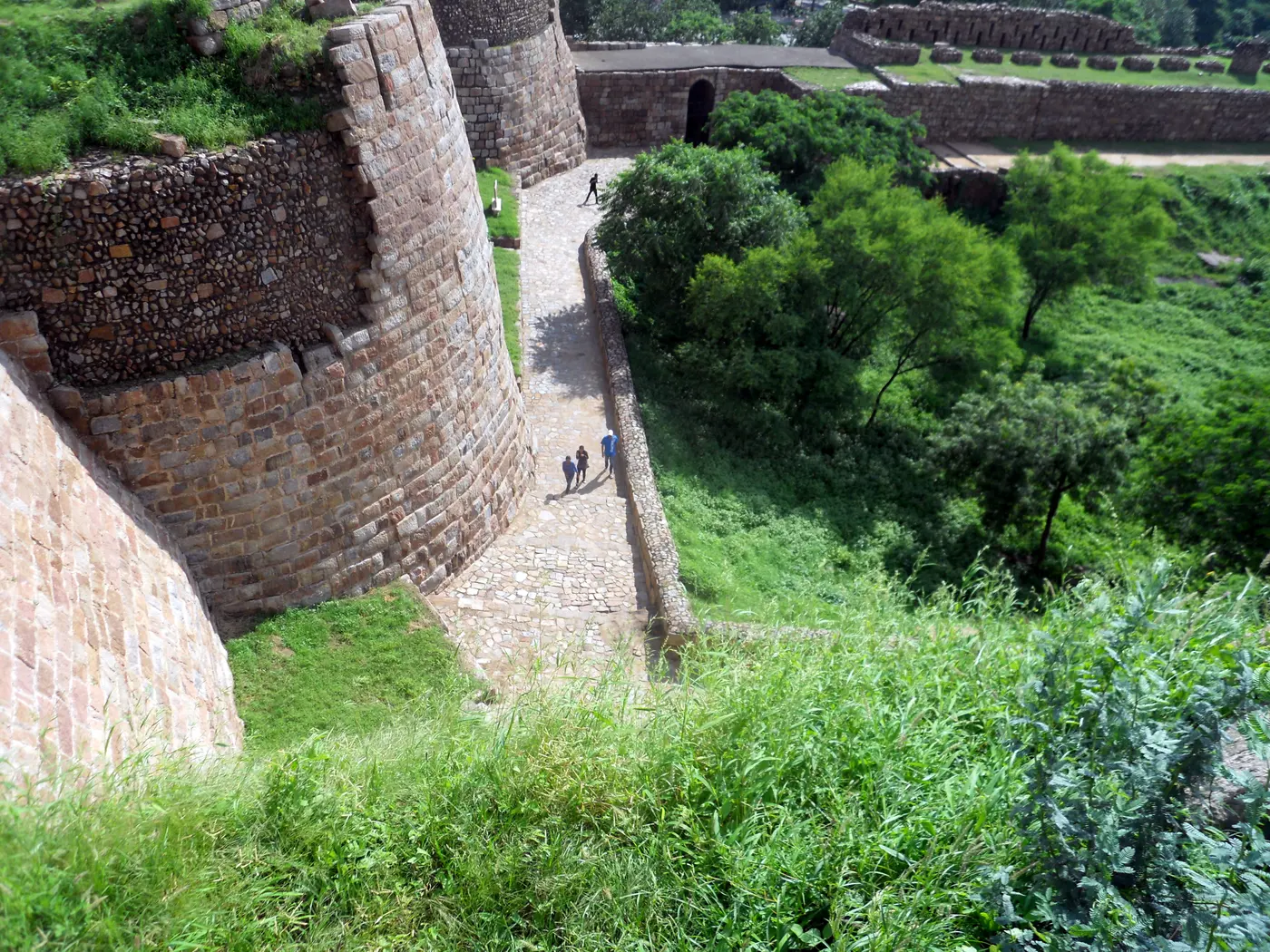
What makes Tughlaqabad genuinely striking isn't any single structure — it's the sheer scale of the fortification. The fort's walls are built from massive, roughly hewn stone blocks, rising in a steep, deliberate sloping (battered) profile rather than standing straight up, giving them both strength against siege and an unmistakable, imposing silhouette against the sky.
The citadel was originally ringed by 13 gates, most of which survive today in varying states of ruin — some collapsed, others still standing tall enough to walk beneath. Walking the circuit gives a real sense of the city's original scale: Tughlaqabad wasn't a fort in the sense of a single palace-and-wall complex, but a genuine fortified city, with a separate walled citadel and adjoining palace area within the larger perimeter.
The stonework has weathered heavily over seven centuries — much of it is bare, sun-bleached, and overgrown with scrub in places — but that roughness is part of the appeal. Unlike the more restored monuments elsewhere in Delhi, Tughlaqabad feels closer to an actual ruin than a curated heritage site.
The Legend of the Curse
No account of Tughlaqabad is complete without its most famous story — a piece of local folklore that's been retold in Delhi for generations, and one worth framing clearly: this is popular legend, not documented historical fact, though it's genuine, well-known lore that shapes how most Delhiites talk about the site.
According to the story, Sultan Ghiyasuddin Tughlaq was racing to build his new fortified capital using a large labour force, at roughly the same time the revered Sufi saint Nizamuddin Auliya, based in nearby South Delhi, was having a stepwell (baoli) dug near his own dargah using the same pool of labourers. When the Sultan issued an order restricting the labourers' working hours — reportedly to slow the saint's project and keep them focused on his fort — Nizamuddin Auliya is said to have responded with a curse, now famous as a short couplet: "Ya rahe ujar, ya base Gujjar" — roughly, "either it will remain deserted, or be inhabited only by Gujjars (herders/shepherds)."
Whatever the historical truth behind the tale, the coincidence that followed is real enough to have fueled the legend for seven hundred years: Tughlaqabad was abandoned as a capital within a matter of decades, reportedly due to water shortages and strategic concerns rather than any curse — yet the story has outlived the mundane explanations, and locals still reference it when talking about the ruins today.
Treat the curse as what it is — a rich piece of Delhi folklore that adds atmosphere to an already atmospheric site, not a historical claim to take literally.
Ghiyasuddin Tughlaq's Tomb
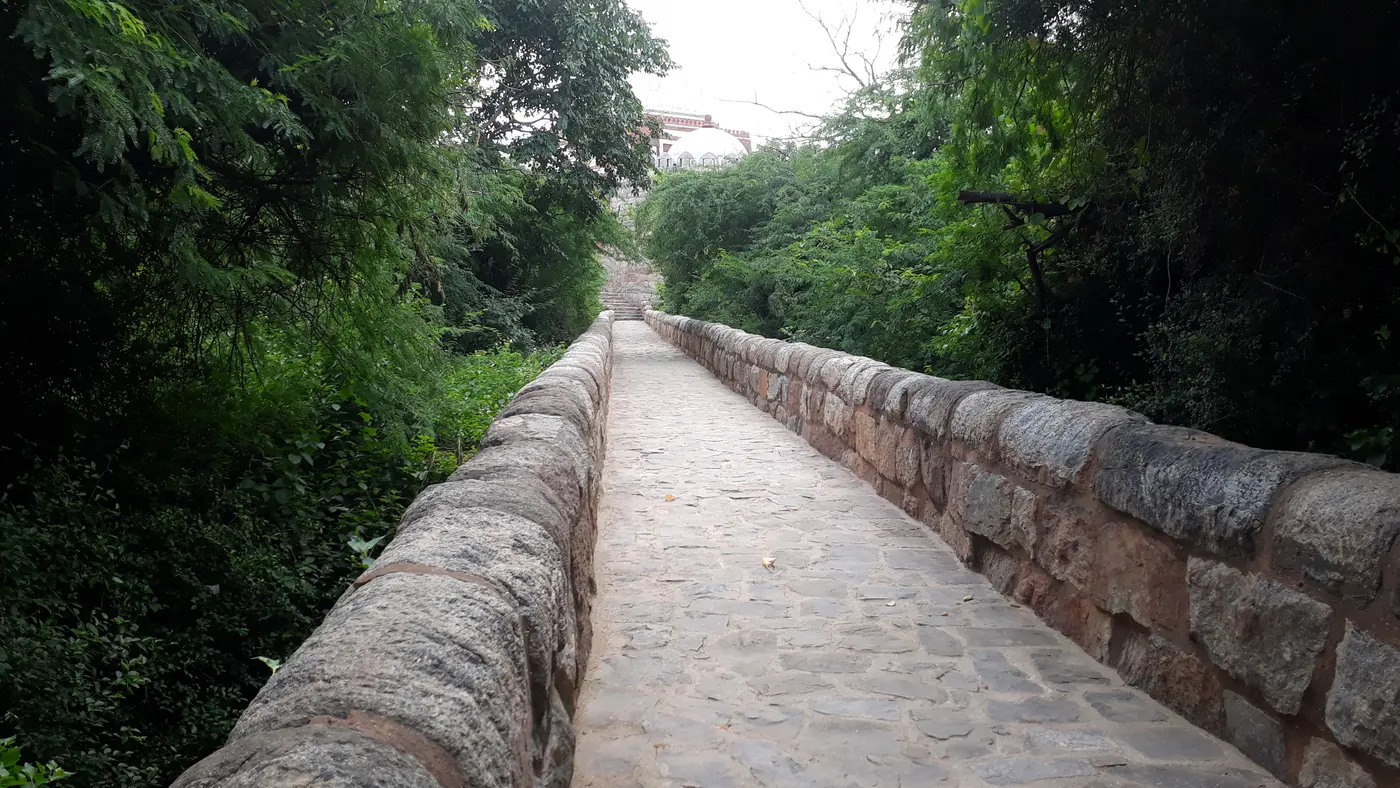
Directly across the road from the main fort complex stands the fortified mausoleum of Ghiyasuddin Tughlaq himself — a compact, sand-coloured tomb with sloping walls that echo the fort's own architecture, set within its own small fortified enclosure. Originally, the tomb was connected to the main citadel by a raised causeway running across what was once a lake or reservoir, a striking piece of engineering for its time — much of that causeway survives and is still walkable today.
The tomb complex is smaller and more intimate than the sprawling fort, and its architecture is considered an important transitional style in Indo-Islamic architecture — the sloping battered walls, red sandstone with white marble accents, and fortress-like solidity set a template that later Tughlaq and Lodi-era tombs across Delhi would continue to draw from.
Most visitors combine the fort and tomb in a single trip — it's a short, easy walk across the road, and skipping it means missing one of the site's most photogenic and historically significant structures.
What's Inside the Ruins Today
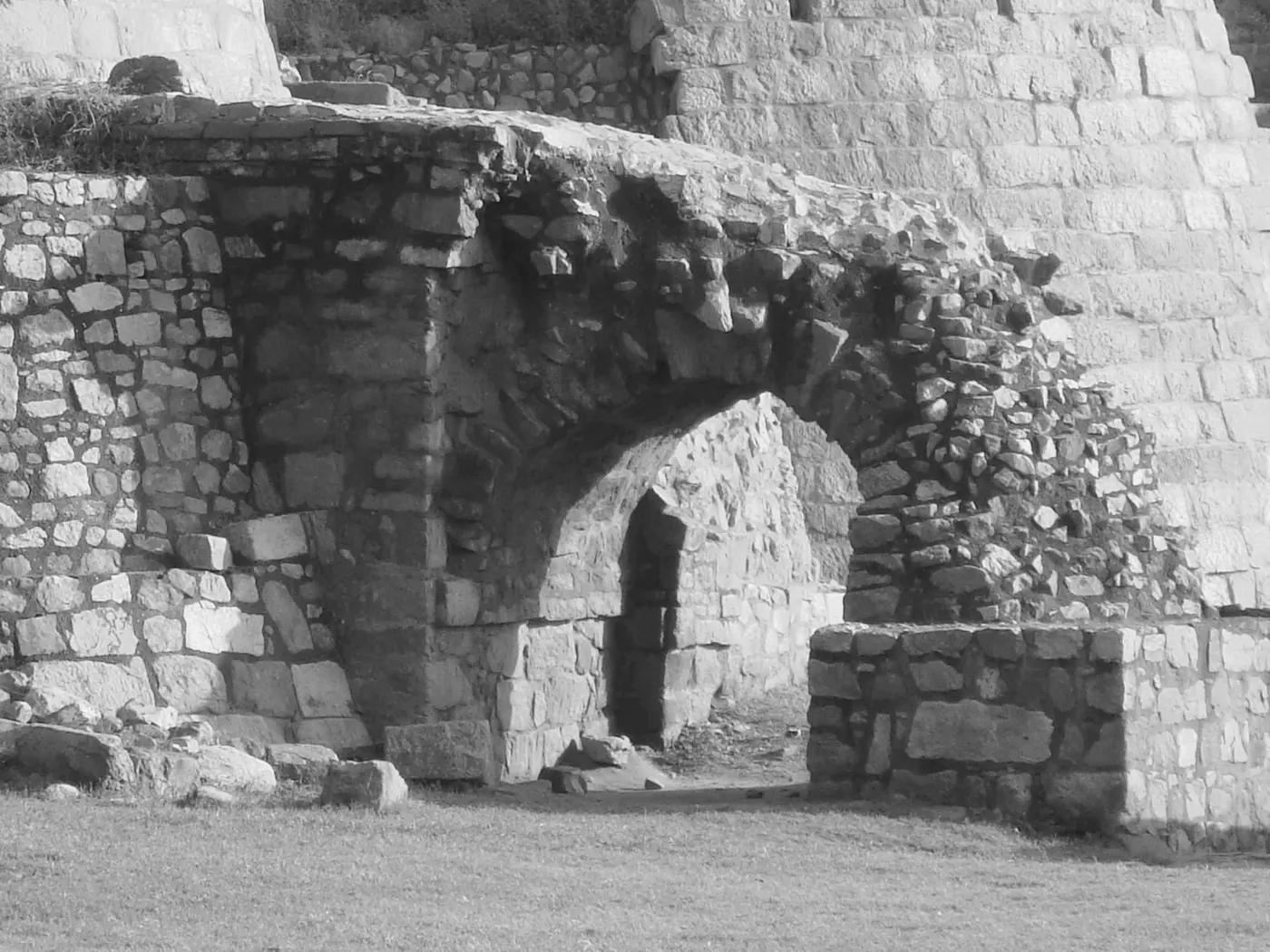
Beyond the outer ramparts and gates, the interior of Tughlaqabad is a genuine maze of ruined structures worth exploring slowly and carefully.
- The citadel: A separate, more heavily fortified inner area believed to have housed the royal palace and administrative buildings — the highest, most defensible point within the larger city walls.
- Baolis (stepwells): Several stepwells survive in ruined form within the complex, remnants of the water-management systems the city depended on — and, by some accounts, a contributing factor in its eventual abandonment when water supply proved insufficient.
- Underground passages: Various tunnel-like passages and vaulted underground chambers run beneath sections of the citadel, thought to have served as storage, escape routes, or defensive features — atmospheric, if not always well-lit or clearly signposted.
- Collapsed palace structures: Fragments of walls, arched doorways, and platform foundations scattered throughout the site hint at the scale of what once stood here, even though most structures are reduced to their bases.
Much of the interior is genuinely overgrown and unmarked — there's minimal signage compared to Delhi's more famous monuments, which is part of the appeal for some visitors and a frustration for others expecting a curated experience.
Photography Tips
Tughlaqabad is, without exaggeration, one of the best photography locations in Delhi for anyone who prefers dramatic, empty ruins over crowded monument shots.
- Golden hour on the ramparts: The sloping stone walls catch low sunlight beautifully in the first and last hour of daylight — the texture of the weathered stone really comes through.
- Wide shots of the gates: Several of the surviving gates frame dramatic sightlines through to the ruins beyond — a wide-angle lens is genuinely useful here.
- Scale shots: Include a person in the frame near the ramparts wherever possible — the walls are tall enough that scale is easy to lose without a human reference point.
- The causeway to the tomb: An atmospheric, less-obvious shot most visitors miss — worth the short detour across the road.
- Empty frames: Because footfall is so low, you can often get entirely people-free wide shots of the ruins, which is genuinely rare at any major Delhi monument.
Suggested Visit Plan
A focused visit to Tughlaqabad Fort and the adjoining tomb comfortably fits into 1.5 to 2 hours, making it an easy half-day add-on to a broader South Delhi itinerary.
Arrive & Enter the Citadel
- ✓Buy tickets at the main entrance
- ✓Walk through the outer gates into the citadel area
- ✓Get oriented — the site is large and mostly unsignposted
Walk the Ramparts
- ✓Follow the walls past several of the 13 gates
- ✓Explore baolis and underground passages carefully
- ✓Stop for photos at golden-hour angles if timed right
Cross to the Tomb
- ✓Walk the surviving causeway or road crossing
- ✓Visit Ghiyasuddin Tughlaq's fortified mausoleum
- ✓Photograph the sloping tomb architecture
Wrap Up
- ✓Head back toward Tughlaqabad metro station
- ✓Grab food nearby before heading onward
Pair this with a visit to Mehrauli's archaeological park the same day — both sit in South Delhi and together make for one of the richest heritage days in the entire city.
Where to Eat Nearby
Tughlaqabad itself is a quiet, largely residential and industrial pocket of South Delhi — don't expect a food scene at the monument gates the way you would near Red Fort or Humayun's Tomb.
- Local dhabas near the station: Simple, inexpensive North Indian food is available around the Tughlaqabad metro station and along the main road — fine for a quick meal, not a destination in itself.
- Head into South Delhi proper: For a wider choice of restaurants and cafés, plan to eat in neighbourhoods like Saket, Hauz Khas, or Greater Kailash after your visit — all a reasonable drive or metro ride away.
- Carry snacks and water: Given the lack of food options right at the site and the exposed, sun-heavy walk inside, it's worth carrying your own water and light snacks rather than relying on finding something nearby.
Budget Breakdown
Tughlaqabad is one of the cheapest heritage visits in Delhi — the main costs are entry tickets and transport, with no real spending pressure once you're inside.
| Expense | Budget | Mid-Range | Comfort |
|---|---|---|---|
| Entry ticket (Indian nationals) | ₹25–₹40 | ₹25–₹40 | ₹25–₹40 |
| Transport (metro/auto/cab) | ₹60 | ₹250 | ₹600 |
| Food/snacks | ₹150 | ₹400 | ₹900 |
| Photography gear/rental | ₹0 | ₹0–500 | ₹1,000+ |
| Total (half-day trip) | ₹250 | ₹700 | ₹2,500+ |
* Entry fees are typically higher for foreign nationals and are revised periodically — confirm current rates at the ticket counter. Prices exclude travel to Delhi itself.
Essential Tips for Visiting Tughlaqabad
- Wear proper walking shoes: The terrain inside is genuinely uneven — loose stone, broken steps, and unmarked drops in places. Sandals or flip-flops are a bad idea here.
- Go with at least one other person: Tughlaqabad is far less monitored and far less crowded than Red Fort or Qutub Minar — safer and more enjoyable explored with company, especially in the more remote sections.
- Carry water: There's minimal shade and few facilities inside the complex, so bring enough water for the full 1.5–2 hour visit.
- Avoid climbing unstable structures: Some walls and passages are genuinely fragile after seven centuries — admire from a safe distance rather than climbing on ruins.
- Start early: Both for cooler temperatures and better light — Tughlaqabad's open, shadeless layout gets uncomfortable fast once the sun is high.
- Combine it with nearby sites: Pair the visit with Mehrauli or a broader South Delhi heritage day to make the most of the trip out.
✅ Do
- →Visit early morning for cooler weather and best light
- →Wear sturdy, grippy walking shoes
- →Carry water — there's little shade inside
- →Cross the road to see Ghiyasuddin Tughlaq's tomb
- →Visit with at least one other person
- →Combine with Mehrauli for a fuller heritage day
❌ Don't
- →Visit alone late in the day or near closing time
- →Climb on unstable or weathered ruins
- →Expect food stalls or shade at the site itself
- →Wander unmarked underground passages without light
- →Rely on finding water once inside — carry your own
- →Treat the curse legend as verified history
Frequently Asked Questions
Is Tughlaqabad Fort worth visiting?
Yes, especially if you enjoy ruins without the crowds. Tughlaqabad is one of Delhi's largest fort complexes, with massive sloping ramparts and 13 gates, yet it sees a fraction of the visitors of Red Fort or Qutub Minar. The trade-off is that it's less manicured and less maintained — go for the atmosphere and scale, not polished museum-style presentation.
What is the legend of Tughlaqabad?
According to well-known Delhi folklore, Sufi saint Nizamuddin Auliya was building a stepwell (baoli) using labourers whom Sultan Ghiyasuddin Tughlaq had also conscripted for his new fort. When the Sultan restricted the labourers' working hours to slow the saint's project, Nizamuddin Auliya is said to have remarked that Tughlaqabad would remain deserted, inhabited only by Gujjars (shepherds/herders) — 'Ya rahe ujar, ya base Gujjar.' This is popular legend and folklore, not a verified historical record, but it's genuinely part of how Delhiites talk about the site to this day.
Is Tughlaqabad Fort safe to visit alone?
It's generally safe during daylight hours, but it's far less monitored and far less crowded than Red Fort or Qutub Minar, with large stretches of ruins, underground passages, and uneven terrain. We'd recommend visiting with at least one other person, sticking to daylight hours, and avoiding the more remote, overgrown sections alone.
How do I reach Tughlaqabad Fort by metro?
Take the Violet Line to Tughlaqabad station, which sits close to the fort. From the station it's a short auto-rickshaw ride or a 15–20 minute walk to the main entrance, depending on which exit you take and the day's heat.
How much time do I need at Tughlaqabad Fort?
Budget 1.5 to 2 hours for a thorough walk through the citadel, ramparts, and main gates. Photographers and history enthusiasts who also want to cross the road to Ghiyasuddin Tughlaq's tomb should allow closer to 2.5–3 hours total.
Is there an entry fee for Tughlaqabad Fort?
Yes, Tughlaqabad Fort is an ASI-protected monument with a nominal entry fee for Indian nationals and a higher fee for foreign nationals, similar to most other ASI sites in Delhi. Fees are revised periodically, so it's worth confirming the current rate at the ticket counter.
Can I visit Tughlaqabad Fort and the tomb of Ghiyasuddin Tughlaq together?
Yes — the fortified tomb sits just across the road from the main fort complex, originally connected to it by a causeway. Most visitors combine both in a single trip, and it's a short, easy walk between the two.
Published by the Kudozz Club editorial team · Last updated · How we research our guides
Want us to plan this trip for you?
Tell Kudozz Club where you want to go and what kind of trip you’re looking for. We’ll build a Delhi itinerary around your dates and budget.
Continue Exploring
View all guides Heritage & Culture
Qutub Minar: History and Visiting Guide
A visitor's guide to the Qutub Minar complex in Mehrauli, Delhi: the 72.5 m minaret begun under Qutbuddin Aibak and completed under Iltutmish, the Quwwat-ul-Islam mosque, the Gupta-era Iron Pillar, the Alai Darwaza and the unfinished Alai Minar, practicalities, the metro, and Mehrauli Archaeological Park nearby.
 Heritage
Lodhi Garden: Delhi's Tombs, Timings & Complete Visit Guide
90 acres of landscaped green in the middle of South Delhi, dotted with 500-year-old tombs from the Sayyid and Lodi dynasties — Delhi's favourite morning-walk park doubling as an open-air museum.
 Heritage
Old Delhi Travel Guide: Red Fort, Jama Masjid & Food
Shahjahanabad, Shah Jahan's 17th-century walled capital — Red Fort, India's largest mosque, cycle-rickshaw lanes, havelis, bazaars, and a street food trail running for well over a century.
 Heritage
Mehrauli Travel Guide: Qutub Minar & Ancient Delhi
Delhi's oldest continuously inhabited settlement — Qutub Minar, the rust-resistant Iron Pillar, a forest full of forgotten tombs, and 800+ years of layered history in one walkable quarter.